1642
 The massacre of Shruel (Shrule bridge) When the great insurrection, or civil war, broke out in October 1641,the English Protestant settlers of North Mayo fled for safety to the castles of some of the principal men in the county. Among these refugees was Dr. John Maxwell, the Protestant Bishop of Killala since 1640.
He, his wife and three children, and some servants, first fled from Killala to Sir Henry Bingham’s castle at Castlebar, but that castle was surrendered by Sir Bingham to Myles Burke, 2nd. Lord Viscount Mayo, who had joined the insurgent Irish. Lord Mayo brought the English refugees to his own castle in Belcarra,where he supported and protected them for some time.
 He then made arrangements to escort them to Shrule and there deliver them over to another escort from County Galway.Accordingly ,on the 9th of february 1642, he, his eldest son Sir Theobald Burke with 5 companies of soldiers, escorted the refugees numbering about 100 persons, toward Shrule which they reached on the evening of the 12th.
Lord Mayo had the refugees well taken care of that night.The next day, Lord Mayo send home four companies of the soldiers and gave over the custody of the refugees to the remaining company of soldiers commanded by one Edmund Burke, brother of Walter Burke of Cloghan in Kilmaine, with orders to escort them into the county of Galway to Kilnemannagh where the Galway escort was to meet them. Lord Mayo directed his son to accompany the escort, and provided Dr. Maxwell and his family with horses. Then he left with two or three men for Cong to shelter from the weather. He was scarcely out of sight when Edmund Burke and the escort fell upon the refugees.

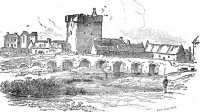
Dr. Maxwell and his wife were stripped naked and the Bishop was wounded by a blow to the Head.Lord Mayo’s son did the best he could to prevent the massacre but the soldiers threatened him, and would have killed him if not for one John Garvey of Lehinch, brother in law of Edmund Burke the captain of the escort, who took him forcibly in his arm, carried him over the bridge and put him on a horse making him ride away.
The killing went on for three hours, until Ulick Burke of CastleHacket and the friars of Ross abbey arrived with help to rescue the survivors, about 40 of them, Dr. Maxwell and his familly stayed at Castlehacket and were seen by a doctor, while the others were lodged in houses around Headford and cared for by the Friars. Lord Clanricarde, sent a strong escort to convey the Bishop and his familly to Galway and later on they were taken by boat to Dublin.
19 Feb. 1642 A letter from the Earl of Clanricarde.
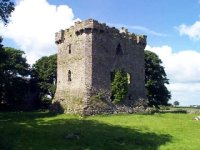
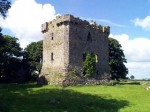
“I received yesterday a large relation of inhuman and barbarous massacre of the poor English, from Pierce Lynch, my tenant in Shruell, who was an eye witness of that cruelty being done upon and on each side of the bridge before the castle; the number of English: one hundred,he affirmed it was done by those in the county of Mayo and who, being before with my Lord of Mayo, would fain have lodged within my castle…..”.

He also relates that the Bishop of Killala, his wife and some of his company were preserved by Ulick Burke, of Castlehacket,who sent carriages to convey them to the castle, being sick and almost starved and some others were kept alive in other places thereabouts. If any in this county had a hand in that work, I shall hazard much to give them their due punishment.
1642 + After the wars of 1641 the ravage caused by the wolves were so great throughout Ireland that they attracted the attention of the state. Wolf hunters were appointed in various districts, including Mayo, who helped to rid the country of these ferocious animals. The last one known to be killed here was in the mountain of Joyce country in the year 1700.
Galway had been peaceful and prosperous for many years but with rebellion all round them the inhabitants of the city started to reinforce their defences. The “official” Major declared that they would defend his majesty to the utmost of their power. On the other hand the catholic Major and corporation, backed by the catholic Warden and vicars, emerged from the shadows and vowed:
“to uphold, maintain and defend, to the utmost of their power, the Roman Catholic religion; and that they would not willingly do, or suffer to be done, any harm or prejudice to any Roman Catholic that shall join in this union”.
They also declared “that their sovereign Lord King Charles to be the lawful sovereign, Lord and King of this Kingdom”.
So the two parties had a common bond of loyalty to the crown and the main stumbling block was their faith, specially the Oath of Supremacy.Shortly afterwards the people, whose fathers a century earlier had passed a by-law “that neither O’ ne Mac shall srutte ne swaggere thro’ the streets of Gallway”, made an alliance with Murchadh O’Flaherty, who was at the head of a considerable force of Irish insurgents, and invited him to come to the assistance of the Catholics of the city. They also appealed to the Catholics of Mayo, both Irish and Anglo-Irish to come to their aid, in defence of their faith.
October 1642 The General Assembly of Catholic of Kilkenny appointed a Supreme council with six members for Connacht: Dr. Malachy O’Queely, Archbishop of Tuam, Dr. John de Burgo, Bishop of Clonfert, Lord Mayo, the same that was in charge of the convoy to Shrule earlier that year, Patrick Darcy, ancestor of the Darcys of Ballybacagh, Houndwood and Gurteen, Sir Lucas Dillon and Geoffrey Browne.Lieutenant-General John Burke was given supreme command of the Catholic armies in Connacht.
